




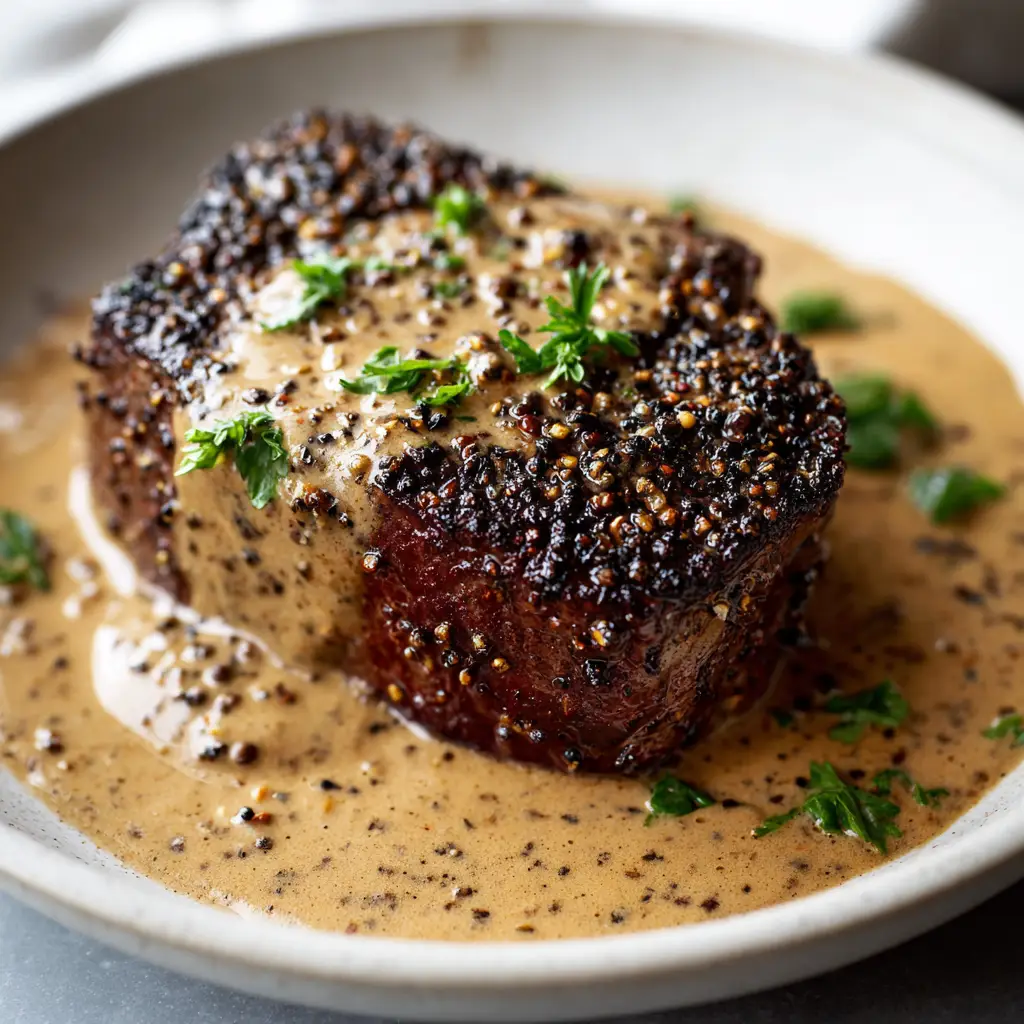
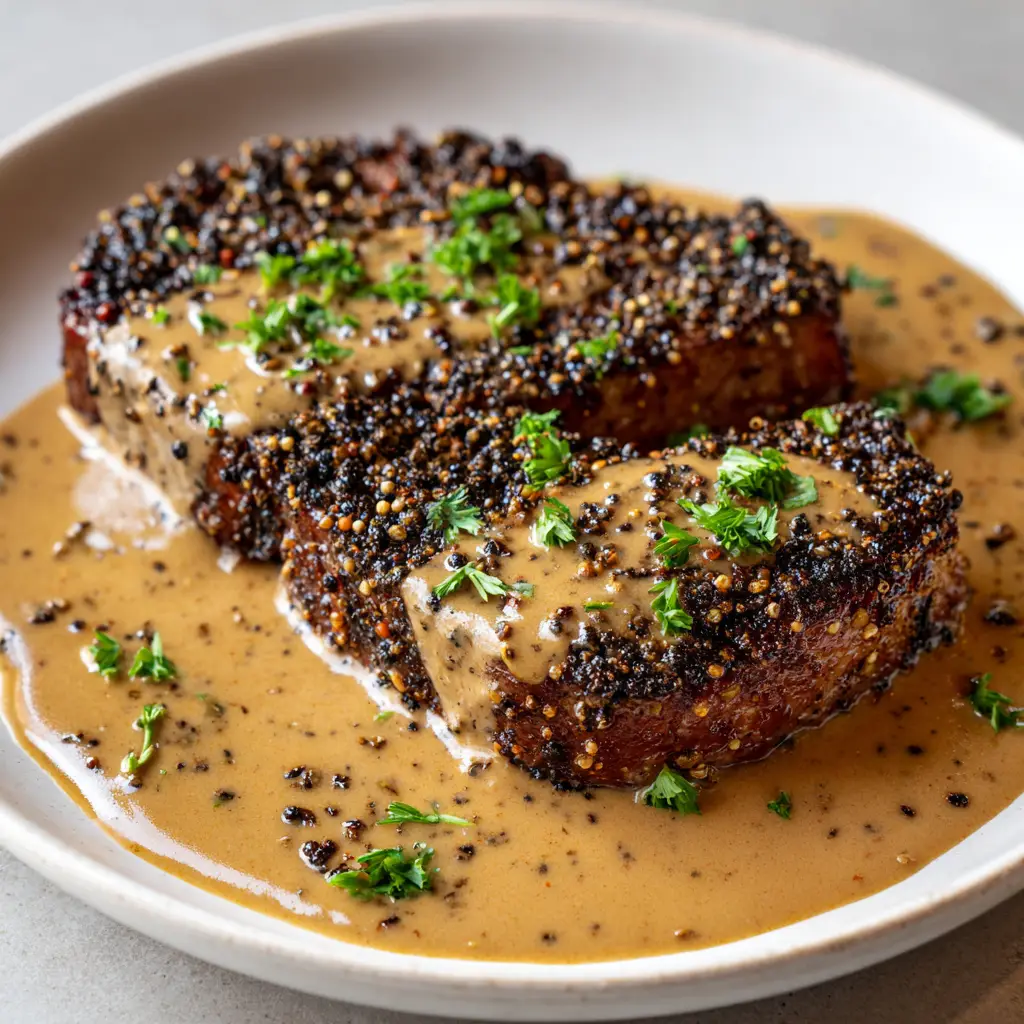
There is nothing quite as breathtaking as a close-up shot of a thick, perfectly pan-seared beef steak with a dark caramelized crust. This classic Steak Au Poivre recipe delivers exactly that, heavily encrusted with coarse cracked black peppercorns that provide a satisfying crunch and a complex, woodsy heat. The true magic, however, lies in the pan drippings.
Once the steak is rested, those flavorful drippings are transformed into a rich, velvety, light caramel-brown cream sauce. This luxurious sauce is speckled with dark pepper bits and generously smothered over the beef, creating a flawless marriage of textures and flavors. To finish, small flakes of freshly chopped green parsley are sprinkled lightly on top as a vibrant, fresh garnish.
Served on a simple round white ceramic dinner plate in soft natural daylight, this dish looks like it came straight from a Michelin-starred kitchen. Whether you are hosting an elegant dinner party or treating yourself to a luxurious weekend meal, this recipe brings French bistro perfection right into your home. Grab your favorite heavy skillet, and let’s master the art of the perfect pepper steak.
Why You’ll Love This Recipe
- Unmatched Visual Appeal: The dark, caramelized pan-seared crust contrasts beautifully with the rich, velvety, light caramel-brown cream sauce.
- Intoxicating Aromas: The smell of toasted coarse cracked black peppercorns mingling with flambéed cognac will make your kitchen smell phenomenal.
- Sensory Perfection: The satisfying crunch of the pepper crust gives way to a tender, melt-in-your-mouth thick-cut beef steak.
- Restaurant-Quality Elegance: This recipe captures the exact unedited, soft-daylight elegance of a high-end French bistro dish.
- Quick and Impactful: Despite its gourmet appearance, this dish moves rapidly from the pan to your simple round white ceramic dinner plate in under 30 minutes.
The Anatomy of a Perfect Steak Au Poivre
Understanding the science behind this dish is the first step to mastering it. Steak Au Poivre relies entirely on the contrast between a sharp, aggressive pepper crust and a soothing, velvety dairy-based sauce. You cannot have one without the other.
The Maillard reaction is your best friend here. This chemical reaction between amino acids and reducing sugars gives browned food its distinctive flavor. Because the steak is heavily encrusted with peppercorns, the heat must be managed perfectly to toast the pepper without burning it to ash.
Furthermore, the creamy light brown cognac pepper sauce acts as a culinary bridge. The alcohol in the cognac extracts flavor compounds from the pepper and beef fond that water or broth simply cannot access. This results in a deeply complex, caramel-brown sauce that cools the palate.
Choosing the Right Peppercorns
You cannot use pre-ground black pepper for this recipe. Pre-ground pepper is far too fine and will turn into a gritty, bitter paste when seared. You must use whole black peppercorns and crush them yourself.
For the best texture, place whole peppercorns in a zip-top bag and crush them gently with a meat mallet or the bottom of a heavy skillet. You are looking for coarse, jagged cracks, not a fine powder. This ensures the dark pepper bits remain distinctly visible in your cream sauce.
When the coarse cracked black peppercorns hit the hot oil, they will release their essential oils. Listen for a subtle popping sound and look for a slightly toasted color. This means the sharp heat is mellowing into a warm, floral spice.
Ingredients & Substitutions
Thick Cut Beef Steaks (Filet Mignon or New York Strip): You will need 2 steaks, each about 1.5 inches (3.8 cm) thick and weighing 8 oz (225g). The thickness is crucial to allow the crust to form without overcooking the center.
Coarse Cracked Black Peppercorns: You will need 2 tbsp (30g) of freshly crushed whole peppercorns. This provides the signature textured crust and the dark speckled bits in the sauce.
Kosher Salt: Use 1 tsp (5g) of kosher salt to season the beef. Salt is a foundational ingredient that draws out moisture, helping the peppercorns adhere to the meat.
Neutral Cooking Oil: Use 1 tbsp (15ml) of avocado or canola oil. You need a high smoke-point oil to achieve the dark pan-seared crust without burning.
Unsalted Butter: You will need 2 tbsp (30g) of unsalted butter. Half is used for searing to encourage browning, and half is mounted into the sauce for a glossy finish.
Shallot: Use 1 medium shallot (40g), finely minced. This is an invisible foundational ingredient that provides a sweet, aromatic backbone to the pan sauce.
Cognac (or Brandy): You will need 1/3 cup (80ml) of high-quality cognac. This deglazes the pan and provides the unmistakable deep, oaky flavor profile of the classic dish.
Beef Stock: Use 1/2 cup (120ml) of unsalted or low-sodium beef stock. This invisible foundation extends the sauce and provides deep, meaty umami to balance the cream.
Heavy Cream: You will need 1/2 cup (120ml) of heavy whipping cream. This blends with the pan drippings to create the rich, velvety, light caramel-brown cream sauce.
Fresh Green Parsley: Use 1 tbsp (4g) of freshly chopped green parsley. These small flakes are sprinkled lightly on top as a garnish to cut through the richness.
Equipment Needed
To achieve the precise visual results of our visual blueprint, having the right tools is essential. Your equipment dictates how heat is transferred to your thick cut beef steak.
- Heavy Stainless Steel or Cast Iron Skillet: Essential for maintaining high, even heat to develop the dark caramelized crust.
- Meat Mallet or Heavy Pan: Required to physically crush the whole black peppercorns into coarse, jagged pieces.
- Long-Handled Lighter or Matches: Necessary for safely flambéing the cognac during the sauce creation.
- Instant-Read Meat Thermometer: The only foolproof way to guarantee a perfectly cooked center beneath the heavy crust.
- Simple Round White Ceramic Dinner Plate: The ideal canvas to showcase the rich caramel-brown sauce and bright green garnish.
Step-by-Step Instructions
Step 1: Prepping and Encrusting the Steak
Remove your thick cut beef steaks from the refrigerator 30 minutes before cooking. This takes the chill off the meat, ensuring it cooks evenly from edge to center. Pat the steaks completely dry with paper towels.
Sprinkle the steaks evenly with the kosher salt. Place your freshly crushed coarse cracked black peppercorns onto a plate. Press the top and bottom of each steak firmly into the pepper.
Use the palm of your hand to aggressively push the peppercorns into the meat. You want the steak to be heavily encrusted, ensuring the pepper stays attached during the high-heat sear.
Step 2: Achieving the Dark Pan-Seared Crust
Place your heavy skillet over medium-high heat and add the neutral cooking oil. Wait until you see wisps of white smoke rising from the surface of the oil. This visual cue means the pan is hot enough for a proper sear.
Carefully lay the pepper-encrusted steaks into the pan, dropping them away from you to prevent oil splatters. You should immediately hear a loud, aggressive sizzle. Let them sear completely undisturbed for 3 to 4 minutes.
Flip the steaks using tongs and add 1 tbsp (15g) of butter to the pan. Baste the steaks with the melting butter for another 3 minutes. The steaks are done when they possess a dark caramelized crust and reach an internal temperature of 130°F (54°C) for medium-rare.
Remove the steaks from the skillet and place them on a cutting board to rest. Do not wipe out the skillet; those dark pepper bits and browned drippings are the foundation of your sauce.
Step 3: Building the Cognac Pepper Sauce
Lower the heat to medium and add the finely minced shallot to the remaining beef fat in the skillet. Sauté for 1 minute until the shallots soften and become translucent. Smell for a sweet, onion-like aroma filling the kitchen.
Turn off your stovetop burner temporarily for safety. Pour the 1/3 cup (80ml) of cognac into the pan. If you are comfortable, use a long lighter to carefully ignite the alcohol, stepping back as the blue flame erupts.
Let the flames naturally die down, which burns off the harsh alcohol bite, leaving only the rich oak flavor. Turn the heat back to medium, add the beef stock, and scrape up all the dark fond from the bottom of the pan.
Simmer the liquid until it reduces by half, which concentrates the flavor. Pour in the 1/2 cup (120ml) of heavy cream. Whisk gently as the sauce bubbles and transforms into a rich, velvety, light caramel-brown cream sauce.
Let the sauce simmer for 2 to 3 minutes until it thickens enough to coat the back of a spoon. Whisk in the final 1 tbsp (15g) of butter for a glossy finish, then remove from the heat.
Step 4: Resting and Garnishing
By now, your steaks have rested for about 10 minutes. This allows the muscle fibers to relax, redistributing the juices so they do not bleed out onto your simple round white ceramic dinner plate.
Transfer the rested steaks to your serving plates. Take a spoon and generously smother the beef with your velvety cream sauce. Ensure the dark pepper bits suspended in the caramel-brown sauce cascade over the sides of the steak.
Take your freshly chopped green parsley and sprinkle small flakes lightly on top of the sauce. This final garnish provides a pop of fresh, earthy color that beautifully contrasts the dark, rich meat.
The Science of the Velvet Pan Sauce
Creating a sauce that doesn’t “break” or curdle requires a slight understanding of culinary science. Heavy cream is robust and resists curdling far better than milk or half-and-half due to its high butterfat content. This makes it ideal for boiling in pan sauces.
The addition of the beef stock provides gelatin (if using homemade) or simple volume that dilutes the intensity of the peppercorns. As the water evaporates during the simmer, the fat droplets from the cream and butter emulsify.
The final swirl of cold butter off the heat is a classic French technique called “monter au beurre.” This step adds a brilliant, mirror-like shine to your light caramel-brown sauce while slightly thickening it to a perfect, velvety consistency.
Expert Tips for Success
- Never Use Pre-Ground Pepper: Pre-ground pepper will burn instantly and taste like ash. You must use coarse cracked black peppercorns to achieve the correct visual and textural result.
- Manage Your Heat: If the peppercorns begin to smell acrid or look black instead of toasted brown, immediately lower your heat. Burnt pepper will ruin the cream sauce.
- Safety First with Flambé: Always turn off the gas burner or remove the pan from the heat source before pouring in the cognac. Never pour directly from the bottle over an open flame.
- Rest the Meat: Failing to rest your thick cut beef steak will result in juices leaking into your sauce, thinning out the velvety texture and ruining the caramel-brown color.
- Adjust the Consistency: If your sauce becomes too thick, splash in a tablespoon of beef stock. If it is too thin, let it simmer for another minute to evaporate more water.
Storage & Reheating/Freezing
Steak Au Poivre is highly sensitive to reheating, as the thick cut beef steak can easily overcook. Store leftover steak and sauce in separate airtight containers in the refrigerator for up to 3 days.
To reheat, slice the cold steak and let it come to room temperature. Gently warm the creamy light brown cognac pepper sauce in a skillet over very low heat. If the sauce separates or looks oily, whisk in a splash of heavy cream to re-emulsify it.
Once the sauce is warm, toss the sliced steak into the pan for just 60 seconds to coat it in the dark pepper bits. Freezing is not recommended for this recipe, as the heavy cream sauce will split and become grainy upon thawing.
What to Serve With This
A dish as rich and intensely flavored as pepper steak demands sides that can absorb the incredible pan sauce. Traditional French pairings usually involve potatoes to contrast the heavily encrusted coarse cracked black peppercorns.
For an indulgent pairing, serve your steak alongside our creamy-mashed-potatoes or the incredibly decadent homemade-scalloped-potatoes. Both options act as the perfect sponge for the rich, velvety, light caramel-brown cream sauce.
If you prefer roasted textures, try our baked-garlic-butter-potatoes, or mix things up with a traditional irish-colcannon-recipe for a cabbage-infused potato side. To add a crisp, fresh element, a crunchy-asian-cabbage-salad offers a bright, acidic contrast to the heavy cream.
If you are planning an entire menu around savory comfort food, you might also enjoy exploring our garlic-parmesan-chicken-meatloaf or the fan-favorite cowboy-butter-steak on another night. For a hands-off approach to beef, our crockpot-steak-and-potatoes is a fantastic weekday alternative.
No elegant dinner is complete without an unforgettable dessert. After enjoying your dark pan-seared crust, follow up with an earl-grey-panna-cotta or a slice of our caramel-brownie-cheesecake. If you prefer fruit-based sweets, an apple-slab-pie is always a crowd-pleaser.
Finally, make sure you have some good crusty bread on the table. A warm slice of sourdough-discard-focaccia or pesto-parmesan-sourdough is absolutely mandatory for wiping your simple round white ceramic dinner plate completely clean.
Frequently Asked Questions
Yes, brandy is an excellent substitute for cognac. Cognac is simply a specific type of high-quality brandy from a designated region in France. Any good quality drinking brandy will provide the necessary oaky flavor for the pan sauce.
While flambéing burns off the harsh alcohol quickly and safely, it is not strictly required. You can simply let the cognac simmer for an extra 2-3 minutes until the strong smell of alcohol dissipates before adding the beef stock and cream.
While it uses a lot of black pepper, toasting the coarse cracked peppercorns in oil mellows their sharp bite, turning it into a warm, woodsy flavor. The heavy cream sauce further neutralizes the heat, creating a perfectly balanced dish.
Filet Mignon and New York Strip are the most traditional cuts. They are tender and can be sliced thick (at least 1.5 inches), which is required to balance the intense heat of the coarse cracked black peppercorn crust.
Your sauce likely broke because the heat was too high, or you substituted milk for heavy cream. Heavy cream has enough butterfat to withstand boiling. If your sauce breaks, whisk in a tablespoon of cold heavy cream or water off the heat to bring it back together.
Closing & Subscribe
Creating this thick, perfectly pan-seared beef steak with a creamy light brown cognac pepper sauce at home is a culinary milestone. The visual reward of the dark caramelized crust and small flakes of freshly chopped green parsley is only matched by the incredible taste.
If you successfully master these coarse cracked black peppercorns and velvety sauce, please leave a comment and a 5-star rating below! Your feedback helps our community of enthusiastic home cooks thrive.
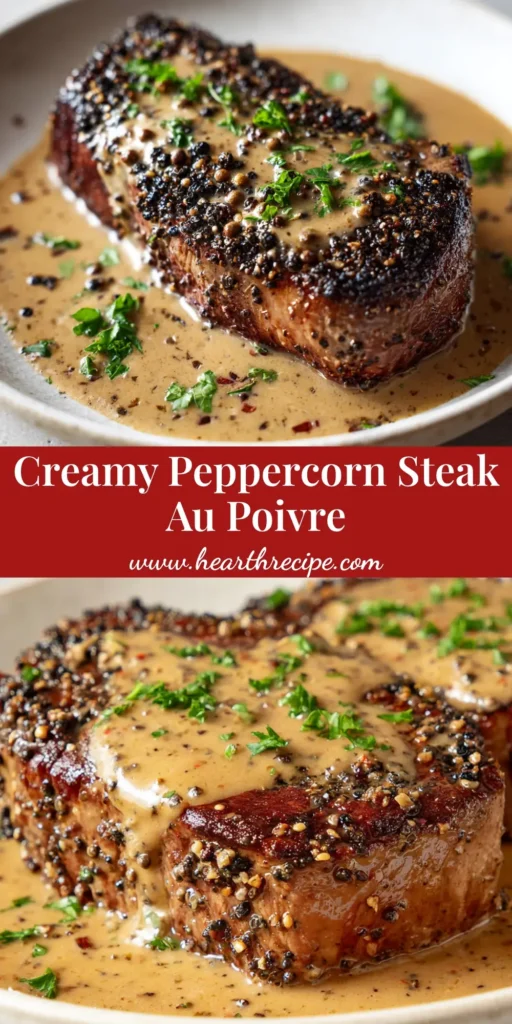
Don’t forget to subscribe to our weekly newsletter for more visual recipe blueprints delivered straight to your inbox. Pin the image below to your favorite Pinterest dinner board to save this recipe for your next special occasion!
Recipe Card
Classic Steak Au Poivre Recipe (Pan-Seared Pepper Steak)
Ingredients
Equipment
Instructions
- Remove the steaks from the refrigerator 30 minutes before cooking. Pat completely dry. Season with kosher salt, then firmly press the coarse cracked black peppercorns into both sides of the meat until heavily encrusted.
- Heat oil in a heavy skillet over medium-high heat until smoking. Sear the steaks undisturbed for 3 to 4 minutes. Flip, add half the butter, and baste for 3 more minutes until a dark caramelized crust forms and internal temperature reaches 130°F (54°C). Remove and rest.
- Lower heat to medium. Add minced shallot to the pan drippings and sauté for 1 minute. Turn off heat, add cognac, and carefully ignite. Once flames die, add beef stock and scrape up the dark fond. Reduce by half, then whisk in heavy cream. Simmer until it becomes a rich, velvety, light caramel-brown cream sauce. Stir in remaining butter.
- Place the rested steaks on a simple round white ceramic dinner plate. Generously smother the beef with the creamy pepper sauce. Sprinkle small flakes of freshly chopped green parsley lightly on top as a garnish.
Notes
Always turn off the gas burner before pouring in the cognac for safety.